


The President of Uzbekistan took part in the EAEU summit
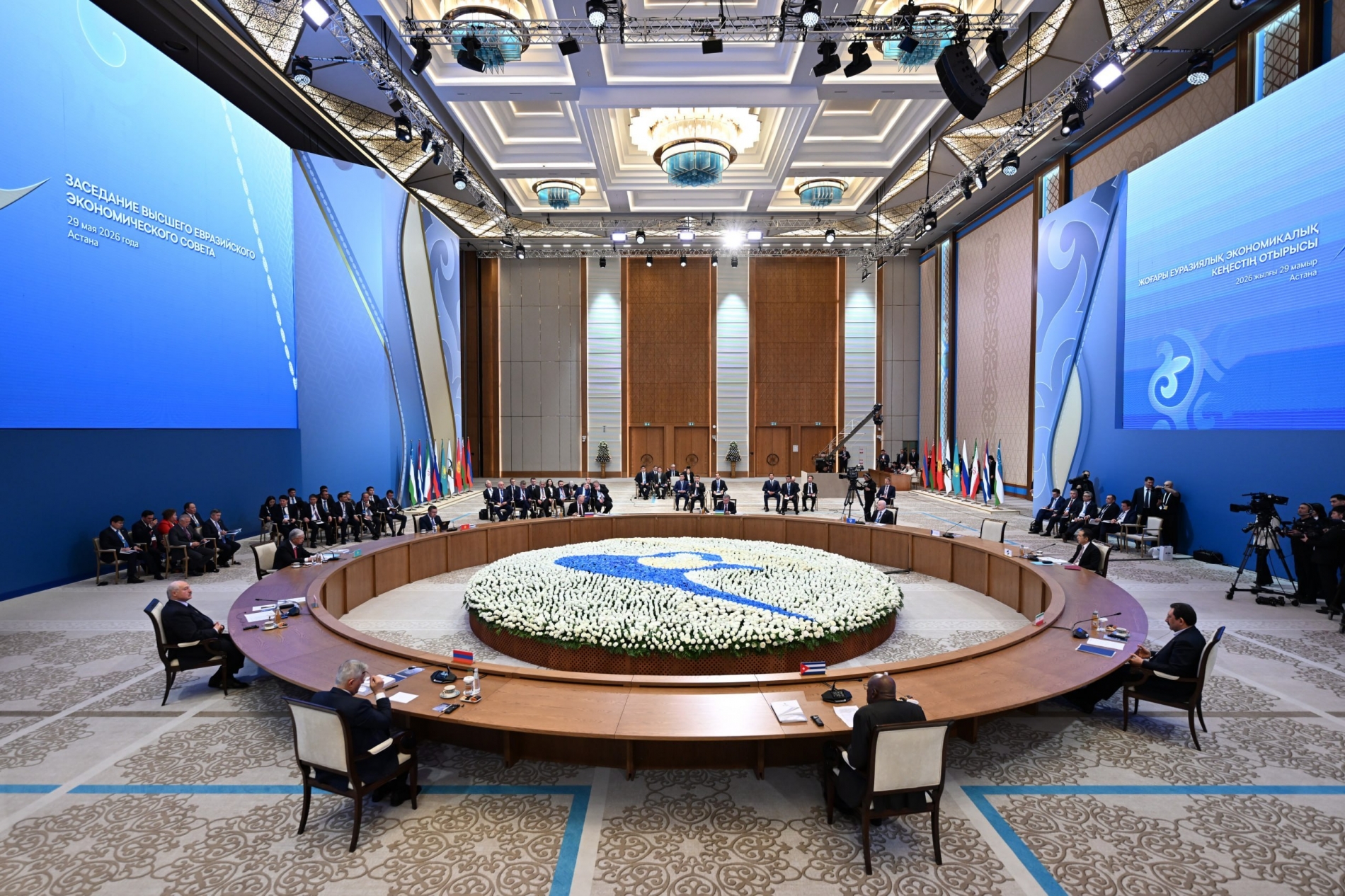
On May 29, President of the Republic of Uzbekistan Shavkat Mirziyoyev attended the regular meeting of the Supreme Eurasian Economic Council in Astana as the head of an observer state, the press service of the head of our state reports.

The meeting, chaired by President of the Republic of Kazakhstan Kassym-Jomart Tokayev, was also attended by President of the Republic of Belarus Alexander Lukashenko, President of the Kyrgyz Republic Sadyr Japarov, President of the Russian Federation Vladimir Putin, Deputy Prime Minister of the Republic of Armenia Mher Grigoryan, Vice President of the Republic of Cuba Salvador Mesa, Minister of Industry, Mines, and Trade of the Islamic Republic of Iran Mohammad Atabak, and Chairman of the Board of the Eurasian Economic Commission Bakytzhan Sagintayev. CIS Secretary General Sergey Lebedev was also present as a guest.
The agenda included issues of further expanding multilateral trade and economic cooperation, supporting industrial cooperation projects, and implementing joint programs in priority areas of interaction.
Opening his speech, the President of Uzbekistan noted that the consistent expansion and deepening of mutually beneficial cooperation with the EAEU countries remains a key focus of our country’s foreign economic policy.
It was emphasized that interaction with the Union states has become a comprehensive economic partnership.
Mutual trade volumes are steadily growing, industrial cooperation is expanding, logistics ties are strengthening, and new areas of cooperation are emerging in the digital economy, energy, and services.
It was noted that this year, jointly with the Eurasian Economic Commission, the implementation of a three-year Action Plan is being completed. In this regard, it was proposed to adopt a new plan at the next meeting of the joint Working Group with the Eurasian Economic Commission, scheduled for this fall in Tashkent.
A roadmap for the convergence of technical regulatory systems between Uzbekistan and the EAEU was recently approved.
Uzbekistan is also actively participating in key Union initiatives, including the development of e-commerce, the digitalization of freight transportation, and the climate agenda.
The Eurasian Development Bank (EDB) has opened a country office in Tashkent. A portfolio of new industrial cooperation projects has been developed jointly with the Bank.
The head of state outlined his vision for priority areas for developing partnership with the EAEU.
Particular attention was paid to the creation of a unified digital space for barrier-free trade between Uzbekistan and the EAEU member states.
In this context, the importance of harmonizing approaches to regulating e-commerce, digital data exchange in the areas of customs, phytosanitary, and veterinary control, certification of origin of goods, and the gradual recognition of electronic documents was emphasized.
Furthermore, it was proposed to begin creating “smart” transport and customs corridors with the implementation of digital transit, connection to traceability systems, and the modernization of border crossing points.
It was noted that the sixth international industrial exhibition “INNOPROM. Central Asia,” held in Tashkent in April of this year, confirmed the growing interest of business circles in localizing production, technological partnerships, and the development of new production chains.
It was proposed to use the potential of this platform to develop a cooperation program between Uzbekistan and EAEU countries. Promising areas include industrial automation and robotics, the production of energy components, water-saving technologies, modern construction materials, and other industries.
The head of state expressed his readiness to establish a joint Project Cooperation Office in Uzbekistan, which, in a one-stop shop format, will work with the Eurasian Economic Commission to select partners, support new initiatives based in the country’s free industrial zones, and assist in attracting financing.
“We are ready to develop additional incentives for high-tech residents from EAEU countries,” the President of Uzbekistan emphasized.
An initiative has also been put forward to adopt a joint Green Industrial Transformation Program aimed at increasing energy efficiency, introducing clean technologies, and reducing the carbon intensity of production.
The practical content of the program may include the formation of a portfolio of joint green projects, the development of new financing instruments, and the modernization of priority industrial sectors using artificial intelligence technologies.
“For our countries, this is no longer just an environmental issue, but also a key factor in the long-term competitiveness of industry,” the Uzbek leader noted.
Share


Objects for investments