



The effectiveness of reforms and priority tasks in the Navoi region were discussed
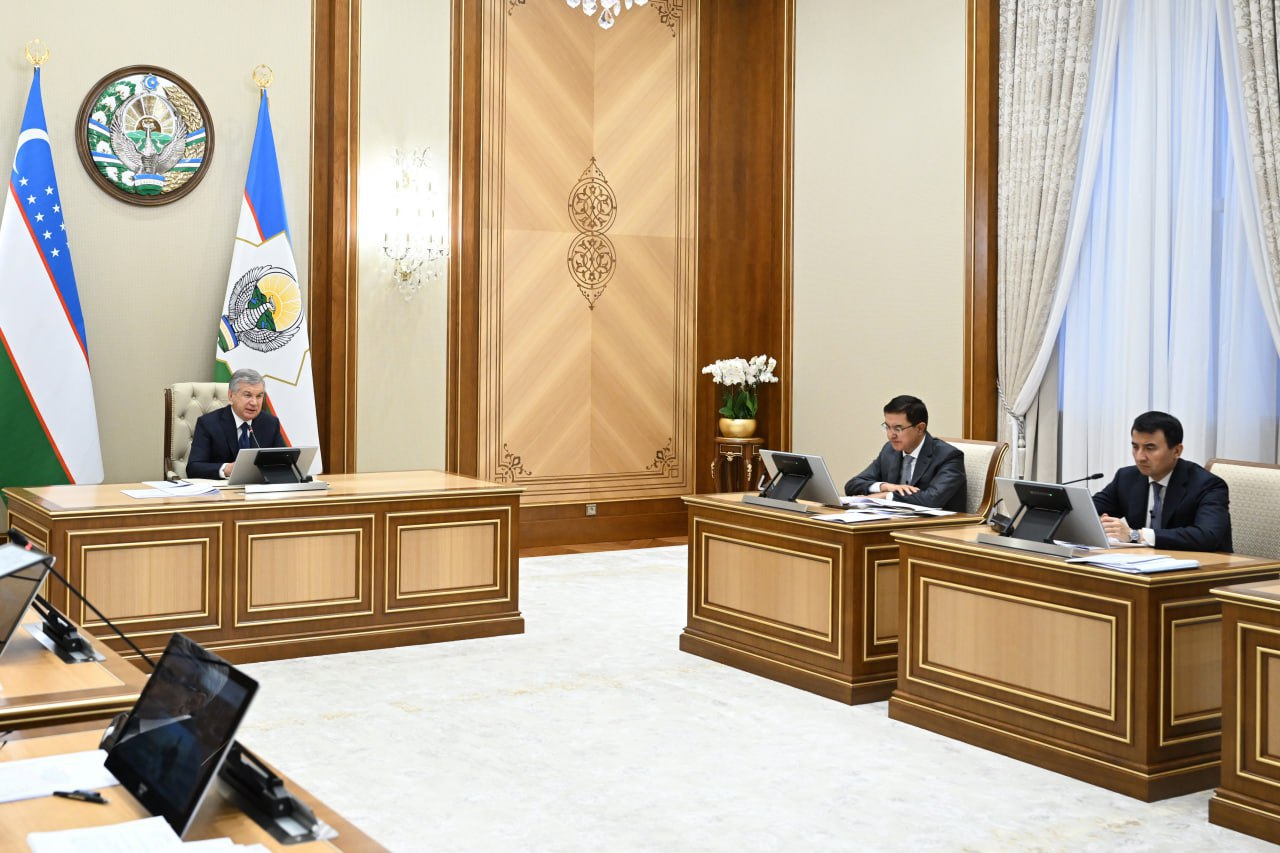
On February 10, President Shavkat Mirziyoyev held a meeting dedicated to the ongoing work and future priorities for the socioeconomic development of Navoi Region, the press service of the head of our state reports.
Previously, when discussing industry in Navoi Region, the primary focus was on large industrial enterprises such as the Navoi Mining and Metallurgical Plant, Navoiyuran, Navoiyazot, and Kyzylkumcement. Investments, jobs, and economic growth were directly linked to the activities of these enterprises.
As a result of ongoing efforts to comprehensively develop the region, diversify the economy, and identify new growth opportunities, regional investment not related to large industrial enterprises reached $1.4 billion in 2025. The goal is to increase this figure to $2 billion in 2026.
At the same time, macroeconomic stability was ensured in the region last year. The gross regional product increased by 7.7 percent to 168 trillion soums. Industrial production grew by 8.3 percent, agriculture by 4.7 percent, and the service sector by 13.7 percent. 161,000 new jobs were created, and unemployment and poverty rates fell to 4.2 percent.
The President of our country emphasized the need to develop each district and city based on their comparative advantages.
In particular, Nurata and Gazgan have great potential in decorative stones and tourism, Tamdy and Uchkuduk in mining, Navbahor in textiles and horticulture, Kanimekh in pasture farming, Zarafshan in jewelry and IT, Karmana in the chemical industry and cultural tourism, and Navoi in mechanical engineering and services.
At the same time, it was emphasized that industrial development remains uneven across districts. Although the region’s per capita industrial output is 177 million soums, this figure remains below the national average in the Tamdy, Nurata, Khatyrchi, Navbahor, and Kyzyltepa districts. However, Tamdy and Nurata are rich in natural resources such as marble, quartz, and basalt.
In this regard, proposals have been approved to create an industrial granite park on a 50-hectare site in the Nurata district, along with a granite processing cluster and decorative stone market. A small industrial zone on a 50-hectare site in the Khatyrchi district will also be established, accommodating high-income projects worth $100 million. A goal has also been set to significantly increase decorative stone production.
To provide these facilities with qualified personnel, a training center for specialists in the mining and chemical industries will be established at the Navoi College of Digital Technologies.
The importance of attracting $4.2 billion in foreign investment to the region this year and increasing export volumes to $1.5 billion was emphasized.
At the meeting, it was noted that it is necessary to support small and medium-sized enterprises in the region and expand their participation in localization processes.
It was noted that existing agricultural opportunities are underutilized, while the region’s 9 million hectares of pastureland are sufficient to transform sheep, camel, and horse breeding into economic drivers. To develop livestock farming, small cattle, pedigree camels, and horses will be imported in 2026.
Overall, 3.3 million hectares of pastureland in the region will be integrated into agricultural production using a project-based approach. Instructions were given to implement measures to combat desertification based on Chinese experience in this area.
Navoi Region is considered one of the leading regions in the country in the field of education. Higher education enrollment is 71 percent; last year, graduates from 10 schools achieved a 100 percent university admission rate.
Starting the new academic year, specialized classes based on the “One School – One IT Class” principle are proposed to be opened in the cities of Navoi and Zarafshan. To this end, 100 teachers from the region will receive advanced training in IT and artificial intelligence in the capital and abroad, and the Zarafshan branch of the Tashkent University of Information Technologies will launch an in-person educational program in artificial intelligence and cybersecurity.
The tourism sector was also discussed at the meeting. By 2026, the Navoi Region plans to attract 600,000 foreign and 3 million local tourists, creating 72 new accommodation facilities and 500 new jobs.
To this end, shopping, entertainment, and recreational facilities will be built on streets connecting 65 mahallas located in district and city centers, as well as in coastal and roadside areas. In addition, guesthouses will be established in 18 mahallas with high tourism potential. Retail and service facilities will also be established in 15 mahallas along international roads.
A national embroidery center is planned for the Nurata district, the Langar and Angidon mahallas are to be developed with a tourism focus in the Khatyrchi district, and four villages in the Nurata and Kanimekh districts are to be converted into tourist destinations.
It was noted that in Navbahor, which is classified as a district with difficult conditions, a master plan could be developed to create a recreational zone around Sarmyshsay, which would triple the tourist flow and create over 200 jobs.
It was noted that Alisher Navoi Park, Lake Yoshlik, and the surrounding areas in the city of Navoi do not fully meet modern requirements. The importance of creating comfortable and modern recreational infrastructure for the population by developing these areas based on a unified concept was emphasized.
The city of Karmane has great potential for tourism development. Since Karmana was located along the ancient Silk Road, it offers the potential to attract tourists traveling from Samarkand to Bukhara and extend their stay by an additional day. In this regard, the proposal to create the “Ancient Karmana” cultural and tourist center on the premises of the Kassym-Sheikh Khanaka, the Mirsaid Bakhrom Mausoleum, the old city market, and the Yangi Avlod Park was supported.
It was emphasized that, drawing on the experience of Saudi Arabia, Qatar, and the United Arab Emirates, it is necessary to develop tourism in the deserts and pastures that occupy a significant portion of the Navoi Region.
Instructions were given to continue improving social and engineering infrastructure. Specifically, between 2026 and 2028, it is planned to gradually replace 312 kilometers of water pipes and 124 kilometers of sewer pipes in the cities of Navoi, Zarafshan, Uchkuduk, and Zafarabad. The goal was also to create modern sanitary conditions in all schools, kindergartens, and medical facilities in the region.
At the end of the meeting, having approved the plans and proposals presented, the head of state emphasized that their implementation should bring about concrete changes in the lives of the population and gave corresponding instructions to officials.
Share


Objects for investments