



New opportunities for the development of the Syrdarya and tasks for their implementation were identified
An extraordinary session of the Kengash of people’s deputies of the Syrdarya Region was held. President of the Republic of Uzbekistan Shavkat Mirziyoyev participated, the press service of the head of our state reports.
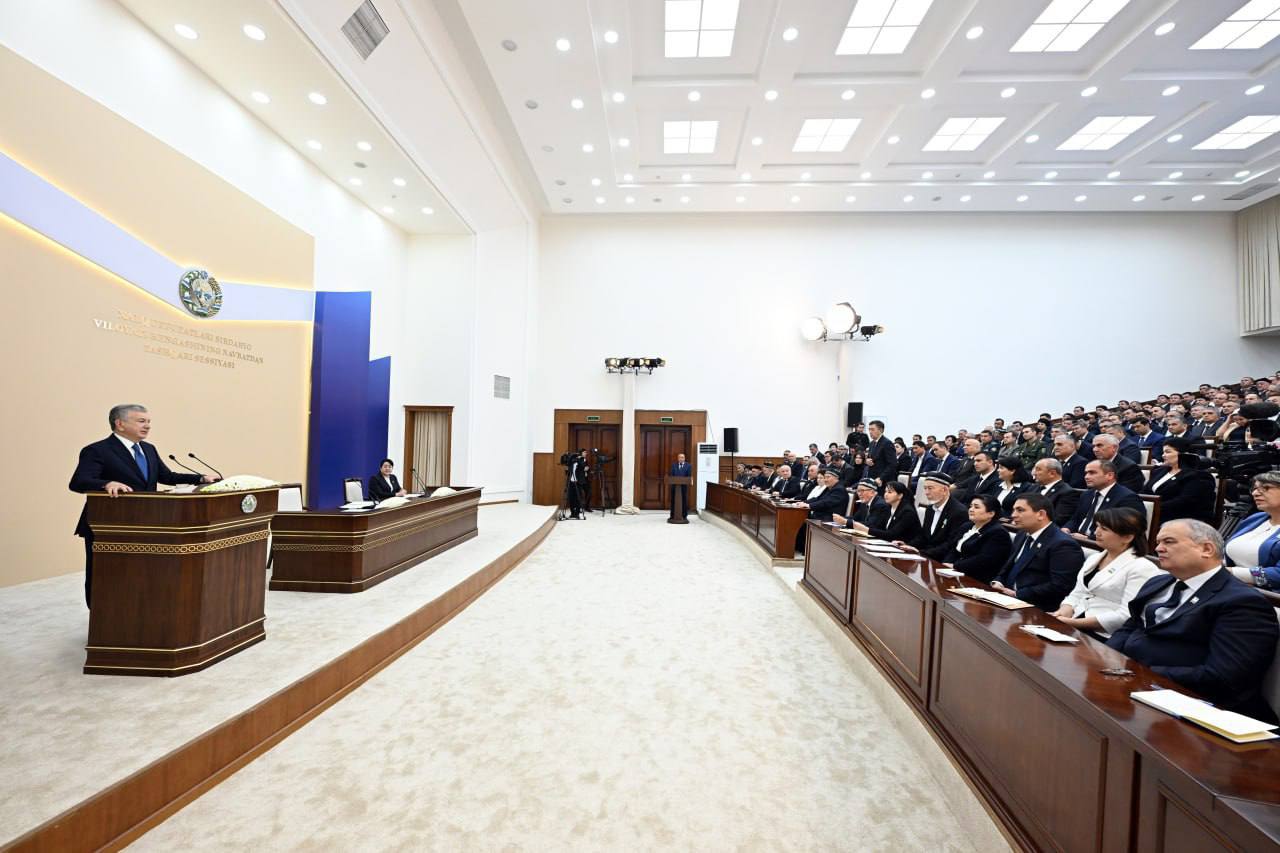
At the beginning of the session, the head of state emphasized that the large-scale changes in the Syrdarya Region are the result of reforms carried out based on the noble principle of “In the Name of Human Honor and Dignity.”
“Previously, this region was focused on agriculture, but in recent years, industry, services, and tourism have emerged from scratch. The business environment has changed dramatically, and a stratum of advanced entrepreneurs has emerged,” the President emphasized.
Over the past eight years, $4 billion in investment has been attracted to the Syrdarya Region. During this period, 187 large production facilities have been commissioned, creating 120,000 new jobs. Production of approximately 50 new products has been launched. As a result, industrial output has increased from 4 trillion to 25 trillion soums.
It was noted that the cities of Gulistan and Yangiyer, as well as the Bayavut, Mirzaabad, Saykhunabad, Syrdarya, and Khavast districts, which previously received subsidies, have now reached self-financing levels.
Next year, a $122 million automobile production project will be launched in the Syrdarya district in collaboration with Chinese partners. Recently, the Center for International Industrial Cooperation of Central Asia was launched in this district in cooperation with Kazakhstan. By the end of the first quarter of next year, 14 industrial enterprises worth a total of $300 million will be operational, and by 2026, another 40 new projects worth $720 million are planned.
The head of state also highlighted the work done to increase the number of places in kindergartens, schools, and medical facilities, as well as to improve the provision of electricity, water, sewerage, and road infrastructure in Syrdarya.
This year alone, $100 million was allocated to improve living conditions. As a result, 47 schools, 45 kindergartens, 31 medical facilities, and five sports and cultural facilities were overhauled and equipped with modern equipment. It was announced that this work would be consistently continued, with an additional $100 million allocated for these purposes next year.
The session also addressed organizational matters. The President nominated acting khokim Erkin Turdimov for the position of khokim of the Syrdarya region. Following a discussion with the region’s leadership, the nomination was put to a vote. Following the vote, Erkin Turdimov was confirmed as khokim of the Syrdarya region.
The head of state set specific goals for the new regional leader for the further development of the Syrdarya region. In particular, he emphasized the need to attract a total of $3 billion in investment to the region in the coming years, increase exports to $500 million, and create 185,000 new jobs.
The meeting addressed issues of further developing industry, services, and agriculture in the region, as well as improving infrastructure.
In recent years, 31 enterprises worth a total of $500 million have been commissioned in the region in cooperation with Chinese investors, providing high-income jobs to 5,000 residents. Work is actively continuing with Chinese partners on another 40 projects worth $700 million.
By incorporating sections of the cities of Yangiyer, Gulistan, and Shirin, as well as the Syrdarya, Bayavut, Gulistan, Mirzaabad, Akaltyn, and Khavast districts, the area of the Syrdarya Free Industrial Zone has been expanded by 1,080 hectares. Regional and district khokims emphasized the importance of launching projects worth at least $4 billion in these new areas.
To this end, the project’s effectiveness has been thoroughly assessed and presentations prepared for investors. A delegation consisting of the khokims of Syrdarya, Bayavut, Gulistan, Mirzaabad, Akaltyn, and Khavast, as well as the cities of Yangiyer, Gulistan, and Shirin, will be sent to the People’s Republic of China.
The objective has been to establish direct cooperation with the provinces of Jiangsu, Shandong, and Guangdong in construction materials; with Tianjin in the chemical industry; with Fujian Province and the Hong Kong Special Administrative Region in electrical engineering; with Shandong and Xinjiang in light industry; and with Shanghai and Jiangxi Province in the pharmaceutical industry.
The creation of an Uzbekistan-Shanghai Cooperation Organization trade and industrial zone in Gulistan, creating at least 5,000 jobs, is also planned. Properties in this area will be offered to entrepreneurs as ready-made projects under industrial mortgage or leasing terms.
It is noted that during the phased relocation of industrial enterprises outside the city of Tashkent, vacant sites in the Syrdarya Free Economic Zone offer significant opportunities for accommodating existing facilities. Therefore, entrepreneurs intending to relocate their businesses from the capital to the Syrdarya region will be provided with land in the industrial zone through a simplified procedure and on preferential terms. They will be provided with preferential loans of up to 10 billion soums, and reduced tariffs will be applied for the transportation of raw materials by rail.
The meeting also discussed issues related to the development of entrepreneurship and service infrastructure.
In 2026, it is planned to allocate 1.5 trillion soums to improve the region’s infrastructure and 10 trillion soums to implement entrepreneurial projects. Of this amount, 753 billion soums will be allocated for the first time to the regional and district budgets of Syrdarya to improve conditions in mahallas.
The President emphasized that it is crucial to continually study and adopt practical experience to implement new approaches and effective solutions for employment and poverty reduction.
To this end, instructions were given to organize internships for the first deputy khokims of 11 districts at the International Center for Poverty Alleviation in Beijing, and to send 50 young residents of Syrdarya to Beijing for an automobile maintenance course.
Furthermore, instructions were given to establish a vocational training center at Gulistan University based on the Chinese “Lu Ban Workshop” program, and to establish a university specializing in pharmaceutical technology jointly with China at the medical college in Syrdarya District.
Special attention was given to the development of agriculture.
Next year, construction of the Sultonhovuz reservoir, with a capacity of 100 million cubic meters, will begin in Bayaut District. This will make it possible to harvest twice a year on 110,000 hectares of land in the Bayavut, Gulistan, Saykhunabad, Syrdarya, and Mirzaabad districts.
The meeting also focused on initiatives aimed at improving the quality of life and business conditions.
Instructions were given to begin the reconstruction of a 37-kilometer section of the A-373 highway running through the Saykhunabad and Gulistan districts, widening it to six lanes. Plans are underway to pave 67 kilometers of roads in 18 mahallas in the Bayavut, Gulistan, Khavast, Mirzaabad, Syrdarya, and Saykhunabad districts with cement concrete.
Two days ago, 29 people were injured as a result of a gas cylinder explosion at a food service establishment located in the clothing market in the Tarakkiyot mahalla of Gulistan.
Unfortunately, this accident took lives. The President expressed his deepest condolences to the families of the victims. He instructed them to receive financial assistance in the amount of 100 million soums within three days.
“Today, we outlined ambitious plans and objectives for the further development of the region, improving the quality of life for the population, and enhancing conditions for entrepreneurs. Without a doubt, relying on the creativity, initiative, and dedication of the people of Syrdarya, we will certainly achieve these goals,” the President said at the conclusion of the meeting.
During the meeting, reports from officials, as well as the opinions and proposals of the participants, were heard.
With this, the head of state concluded his visit to the region and returned to Tashkent.
Share


Objects for investments