



New initiatives for the development of urban development and housing construction were considered
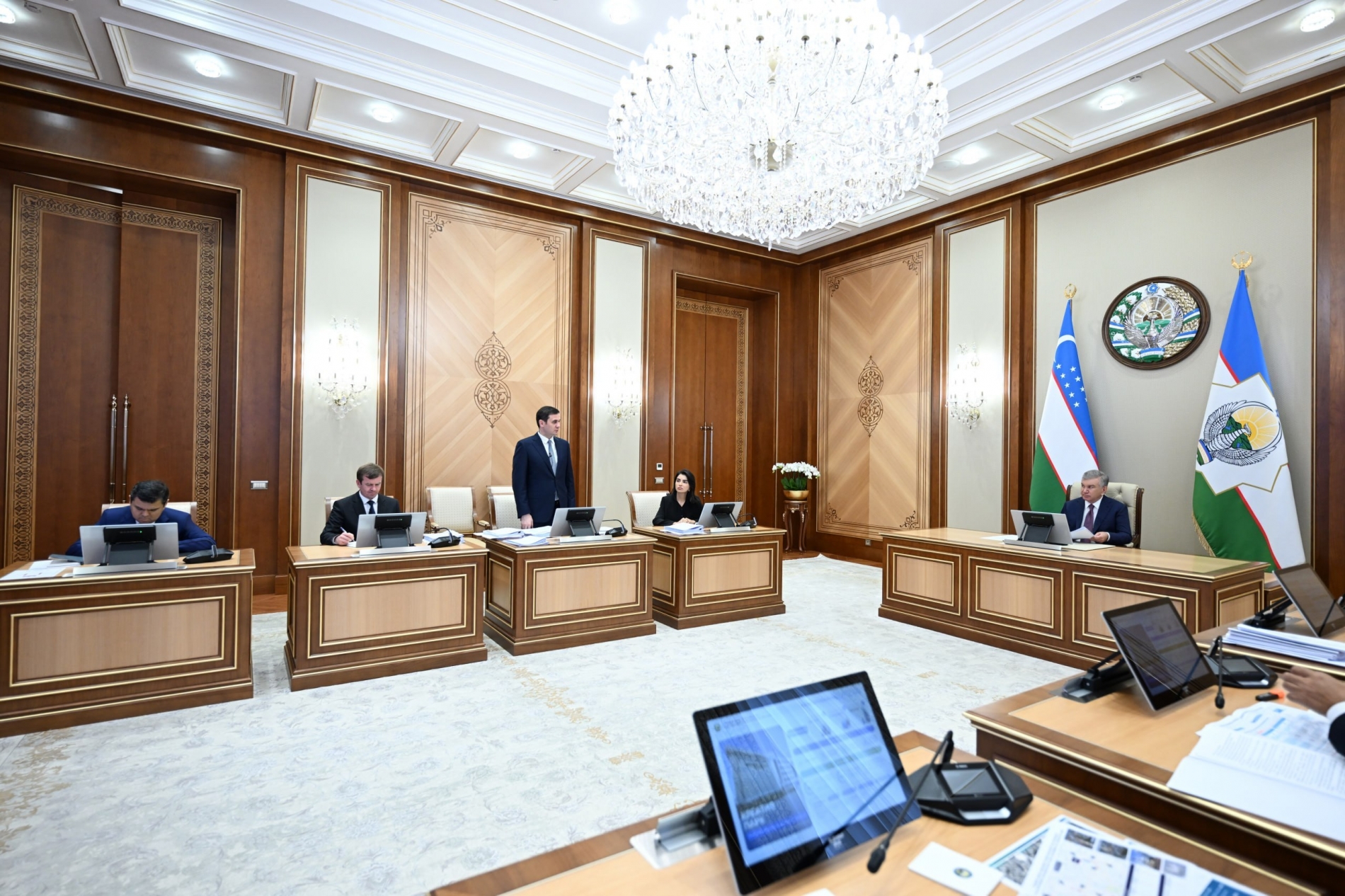
President Shavkat Mirziyoyev reviewed a presentation on improving the effectiveness of reforms being implemented in the fields of urbanization and urban planning, the press service of the head of our state reports.

In recent years, the share of the urban population in our country has exceeded 50 percent, and this figure is expected to continue growing in the coming years. Population growth and increasing construction activity make it increasingly important to develop urban planning schemes that meet modern requirements, preserve green areas, protect historical and cultural heritage, and ensure the balanced development of engineering and transport infrastructure.
To date, 2,506 out of 8,604 settlements across the republic, or 29 percent, are covered by master plans. In 2026, master plans are expected to be developed for another 154 settlements, and in 2027 for an additional 144 settlements. Of the currently effective master plans, 1,044 have been converted into digital format.
At the same time, although 275 development master plans for specific territories were prepared in 2024–2025, they are not maintained within a unified register and are not integrated with general master plans. This creates a number of challenges in the comprehensive development of territories and the coordinated planning of infrastructure, transport, utility networks, and social facilities.
In this regard, a new system for working with master plans and development plans has been proposed. Under this system, the first stage will involve the complete collection and updating of information on master plans, the second stage will focus on digitalization, the third stage will establish a monitoring system, and the fourth stage will create a comprehensive information and analytical system.
As part of this process, a unified electronic register of urban planning documentation will be maintained. Documents that are not registered will not have legal force. Additional responsibilities will be assigned to the Urbanization Center, including maintaining the urban planning geographic information system, coordinating topographic and geodetic works within integrated construction processes, and providing methodological support to regional architectural and planning councils.
There is a growing demand for mid-level and highly qualified specialists capable of working in urban planning, geodesy, cadastre, design, agglomeration management, and geographic information systems.
For this purpose, it has been proposed to reorganize the Tashkent Geodesy and Cartography Technical College into the Technical College of Urban Planning, Geodesy and Cadastre. The institution will train mid-level specialists in surveying, cadastre and geodesy, computer graphics and design operators, as well as specialists in computer-based cadastral software.
Within the higher education system, it is planned to establish a Faculty of Modern Urban Planning and Agglomeration Management at the Tashkent University of Architecture and Construction.
It has also been proposed to establish creative parks in all regions, bringing together urban planning, design, and architecture. These parks will include laboratories, engineering workshops, software and design services, as well as facilities for onboarding, networking, and co-working. Residents of the creative parks will be granted personal income tax and social tax benefits.
The presentation also addressed the issue of strengthening liability for violations in the construction and urban planning sector. It was noted that problems such as illegal and unauthorized construction, deliberate delays in construction timelines, and inefficient land use persist.
It was pointed out that the current fines do not provide a sufficient deterrent effect. In 2025, 1,952 illegal construction projects were identified. In this regard, it was proposed to strengthen financial sanctions for violations.
The situation in the field of shared-equity residential construction was also analyzed. In recent years, the volume of such housing construction has increased 2.5 times and exceeded 11 million square meters last year. At the same time, the number of violations related to shared-equity housing construction has also increased. Last year alone, nearly 3,000 citizens suffered losses totaling 668 billion soums.
In this regard, a draft law on shared-equity construction has been developed. It provides for the regulation of shared-equity construction projects based on new approaches, the protection of citizens’ funds, and the transparency of construction processes.
A new financing mechanism for shared-equity construction — escrow accounts — was also discussed. Under this system, buyers’ funds will be held in special accounts at authorized banks and transferred to developers only after construction work has been completed in accordance with established conditions.
The escrow system is based on four key principles. First, funds held in escrow accounts cannot be used to satisfy creditors’ claims. Second, investors and developers may operate only through authorized banks. Third, funds are transferred to the developer after the signing of the transfer and acceptance certificate. Fourth, if the contract is terminated, the participant’s funds are returned in full.
A central element of the new system will be the unified “Uy-joy” information platform. All construction processes will be conducted in an open electronic format on the platform, integrating data on developer ratings, permits, project documentation, construction progress, escrow accounts, and contracts.
The presentation also noted that information on a single construction project is currently maintained across several information systems. Due to the lack of integration between systems such as “UzKad,” “E-auksion,” “E-qaror,” “Shaffof Qurilish,” and “Mening Uyim,” data on land plots, project documentation, expert reviews, construction permits, and commissioning are generated separately.
In this regard, it was proposed to introduce a unified identifier, a digital territorial passport, a digital project passport, and a digital facility passport into construction processes. This will make it possible to cover the entire lifecycle of a facility within a single digital environment.
Particular attention was paid to issues of urban renewal. It was noted that modern, energy-efficient apartment buildings equipped with the necessary infrastructure could be constructed in place of the 17,000 residential buildings built in the republic before 1991.
Until now, there has been no unified law regulating urban renewal processes. Therefore, a draft law on urban renewal has been developed. It provides for a clear definition of renewal zones, procedures for obtaining residents’ consent, compensation and resettlement mechanisms, investors’ obligations, and the powers of government authorities.
Through urban renewal projects, it is planned to modernize the outdated housing stock, create safe and comfortable living conditions for residents, upgrade utility and engineering networks, and expand green spaces and social infrastructure.
The President emphasized that reforms in urban planning and urbanization should be based on the principles of creating a comfortable living environment for the population and ensuring sustainable development.
Relevant officials were instructed to digitalize master plans and development plans, launch the unified “Uy-joy” platform, ensure guarantees of citizens’ rights in shared-equity construction, introduce escrow mechanisms, and establish clear and fair procedures in the field of urban renewal.
Share


Objects for investments